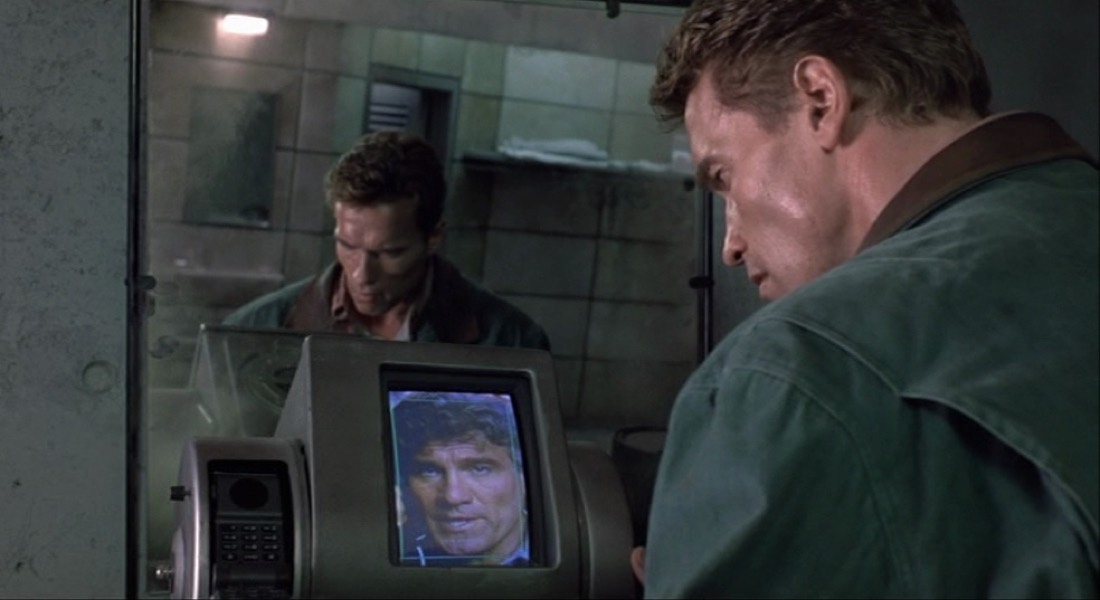
Total Recall was released in theaters more than thirty-five years ago. I rewatched it recently, half expecting it to feel dated. It did not.
Alex Garland's Civil War unsettled me because it felt eerily accurate—a contemporary America fracturing in real time. Total Recall reaches much further into the science-fiction genre, full of mutants and Martian colonies. But compare its predictions to twenty-first-century technology and it does not feel too far off. Biometric scanning, driverless cars, holograms used as decoys—the film imagined all of them. And while it imagined Mars, SpaceX, Blue Origin, and NASA are busy turning space travel into reality. The future Verhoeven dressed up as camp keeps arriving on schedule.
The idea at the center of the film is the one that fascinates me most. Rekall is a company that sells memories for leisure—a vacation implanted straight into your mind, promised to be better than the real thing. No car breakdowns. No stomach bugs. None of the unpredictability that comes with actually going somewhere. Just the perfect trip, remembered as if you had lived it.
Is that actually possible? I am not sure. We have brainwashed people before, through visual stimulation and electric shock—but cracking the neuronal code well enough to write a memory from scratch feels much harder. The film does not pretend to know either. What it understands is something more important: how easily a technology like this could be commercialized, and how easily it could then be turned against the people who buy into it.
That is what stayed with me. Rekall sells leisure, but the same machine that implants a pleasant memory can erase an inconvenient one. It reminded me of the heated debate around artificial intelligence—how a government could use it for civilian surveillance, criminal profiling, and weaponization on a massive scale. These are familiar topics for dystopian stories, and Total Recall hints at them quietly while you are busy watching Arnold dodge bullets. The idea came from Philip K. Dick's short story “We Can Remember It for You Wholesale,” and Dick's real question—who owns your memory, and therefore who owns you—survives the trip to the screen intact
Paul Verhoeven is a master storyteller, and his films are satirical and sexy. RoboCop was a dark, gory action film built on a perfect satire of corporate greed and the militarization of law enforcement. Total Recall keeps going. Here the villain is a corporation that monetizes the oxygen on Mars, alongside a state-sanctioned media that bends the truth on command. But Verhoeven never lets the message smother the fun. There are comical, slapstick moments too, with delightfully animated dialogue.
The film belongs to Arnold Schwarzenegger. By 1990 he was already a Hollywood fixture, and Total Recall cemented him as a leading man who could carry a blockbuster on presence alone. Douglas Quaid—a construction worker who suspects he has lost a memory, only to learn he may be a secret agent with a mission on Mars—is a perfect fit for him. The journey is highly entertaining. I want to credit the action sequences and the editing especially; they are elaborate without ever becoming incoherent, and the storytelling stays clear even as the plot folds in on itself. There are memorable scenes that are classics now, thanks to early CGI and practical effects that still hold up well. There is no doubt the production design and landscape art are gorgeous—and influential for the genre films that came after.
There was a remake in 2012 by Len Wiseman, who directed the gorgeous vampire film Underworld. I thought it was unnecessary—an ordinary action film that mistook gloss for vision.
Total Recall remains one of the essential action science-fiction films of its era. It dressed prophecy up as a popcorn spectacle and dared you to laugh along. The trick is that the prophecy does not stay funny. The film promised a memory better than reality—and reality keeps catching up.