A formulaic premise is not a death sentence. I recently watched The Beast in Me on Netflix, and it reminded me how much life a familiar setup can still hold when the writing trusts its actors to carry the weight underneath. The Hunted had every ingredient to do the same thing. It did not. Two leading men with captivating screen presence are stranded in this film, and I kept circling the same question. Why not give them better lines? The dialogue is outdated and redundant, and it wastes the two people best equipped to elevate it.
The strange part is that the talent was never the problem. William Friedkin directed this one late in his career — the same filmmaker behind The French Connection and The Exorcist — and his instinct for staging tension still surfaces in flashes. The knife fights are brutal and precise. The craft is competent. But competence is not the same as depth, and the camera keeps chasing the hunt when the story was begging it to turn inward.
The story revolves around an elite soldier trained for secret missions who goes rogue, and the man who trained him is pulled in to stop him before he kills civilians. Perhaps you do not need to be extensive about his origin story. But this setup hands you so much to work with — room for philosophy, room for a real study of human nature. Lean into empathy, and it becomes a story about two damaged men who see the world the same way and cannot forgive each other for it. Strip it down to something raw and blunt and stylish, and it becomes a lean fable about violence and the wild. Either direction would have worked.
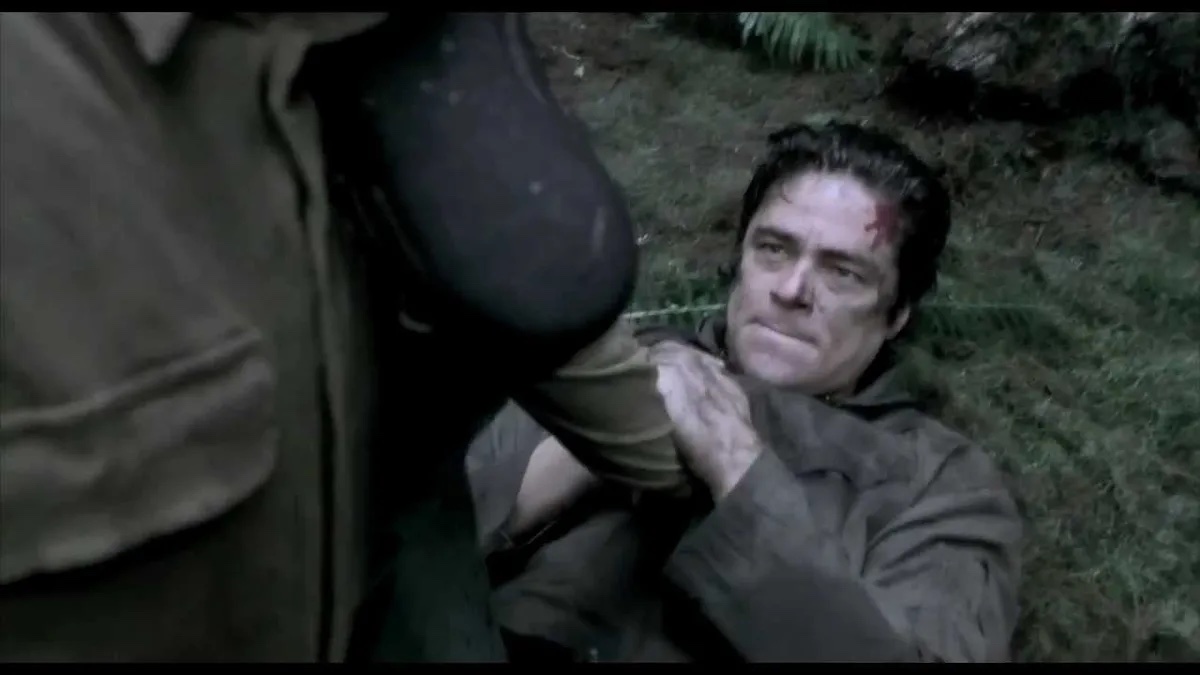
But where the movie leads is deeply disappointing. It offers a handful of hand-to-hand combat scenes that serve no purpose beyond function — a way to escape, a way to keep being an action movie. That is all. I wanted the film to use its two leads the other way, to let their dialogue crack open psychology and character in depth. Bonham (Tommy Lee Jones) and Hallam (Benicio del Toro) clearly share a conviction — both are set against human cruelty and the disruption of nature. There is a genuinely charged sequence when Hallam confronts the deer hunters in the forest, and it hints at everything the film could have been. I wish it had stayed there longer. I wish it had traced that shared conviction back to their history and shown us exactly where the two men break apart — what it is they cannot agree on.
Because something did happen between them. Bonham carries regret through the entire film. When he finally fights and kills Hallam, there is a sadness in his face that the movie never bothers to explain. What is it? Is it the reason he burned all of Hallam's letters? The film raises these questions and then walks away from every one of them.
There are cracks in the storytelling too. Bonham describes Hallam as different, emotionless, wired in a way the rest of us are not. The film never earns that description. I was never convinced Hallam could be a psychopath — his lines were conspicuous and flat, with no layers underneath them. This is exactly where voiceover could have rescued the film. It opens and closes with narration and then abandons the device completely. Why not carry it all the way through? Inner dialogue — Hallam's own voice, his own reasoning — might have let us understand him. It might even have let us relate to him. Instead, he stays a locked door.
Bonham and Hallam spend the entire film tracking each other through the wilderness. But the more interesting hunt — the one for who these men actually are, and for whatever broke between them — never begins. You cannot follow a character you are not allowed to hear. And a story that refuses to look inward has nowhere left to go but the next fight.