I am drawn to films and shows that place culture and tradition at the center, regardless of genre. Not because I find them educational, and not because I think they carry some higher virtue. I am drawn to them because they feel meaningful — meaningful in the way a story becomes when it is personal and authentic to the people who made it.
There are Korean films I return to for exactly this reason. Films that touch traditional values and, somehow, touch my own life along the way.
Hi, Dharma! (2001) made Buddhism approachable. It treated faith less as a strict religion and more as a way of living. I loved its theme of redemption, and its quiet reminder that human nature can hold its ground even in hardship.
Shiri (1999) is a different kind of memory. It was not only a milestone in South Korean cinema — it left a permanent mark on my childhood. It taught me that a trip to the theater could be exhilarating, and that an action film could carry real dramatic weight. Shiri defined a piece of who I am, and it showed the potential of South Korean entertainment long before K-drama and K-pop became a global phenomenon.
The Wailing (2016) gave me chills that lingered down my spine for days. It is occult, supernatural horror done right — shocking twists, a tone that stays dark while still holding the warmth of a rural village, tragic mysteries that never fully let you go. It remains one of my favorite films of all time, one I keep returning to in my head. What blew me away most was how tightly Na Hong-jin wrote it. I recently rewatched his debut, The Chaser (2008), and it holds up — it even foreshadows the obsessive, monster-focused detail of his later work. The ending of The Wailing still haunts me every time. I smile when it is over, not because it ends happily, but because the experience is purely, completely satisfying.
Jeon Woo-chi: The Taoist Wizard (2009) is where I go when I want escapism and a feel-good afternoon. Director and writer Choi Dong-hoon has a distinct style — lighthearted adventure, colorful characters, and lively dialogue that somehow carries a complex story without ever dragging. His earlier films, The Big Swindle (2004) and Tazza (2006), were just as entertaining and just as tightly built, which still surprises me when I remember they came out of the early 2000s, when mainstream Korean film was still finding itself. In Jeon Woo-chi, every character is likable — even the villain — and the way the story moves between two distant eras feels effortless. The character arcs land completely.
Bedevilled (2010) is the last on this list, and it does not flinch. It looks straight at an indifferent society, at the selfishness of modern life, at the vulnerability of the socially weak — and then at the rage that builds until it erupts into catastrophic revenge. The film could coast on shock value alone. But what I want to point to is Seo Young-hee's performance as Kim Bok-nam. She is the very definition of weak, vulnerable, a victim of her circumstances in too many ways to count — and yet she holds onto her humanity right up to the breaking point. I found it devastating. I found her relatable. I would have wanted to protect her if I were her friend. The film builds its suspense steadily and never lets the tension go, all the way to the final frame. It studies human nature and pushes it to the edge until Kim's sanity finally gives. And underneath all the gore and violence, I felt something closer to grief — knowing that the wrongs in this film could be happening, right now, somewhere in rural South Korea.
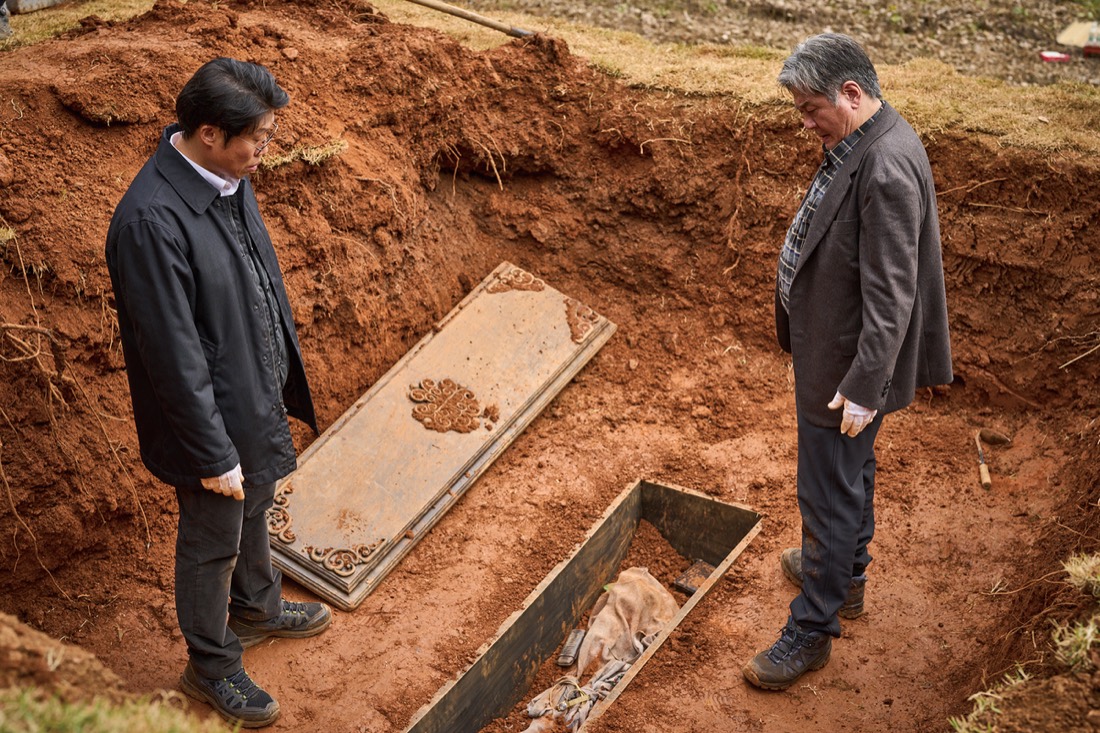
This long preface was always leading here — to Exhuma (2024).
I love this film, and I love its quiet insistence on stoicism. It is a near-perfect supernatural occult horror, and it lives inside Korean subculture rather than merely borrowing from it. What I admire most about director Jang Jae-hyun is his refusal to leave this genre. His debut, The Priests (2015), was a major hit, even if it felt like an incomplete story — a premise whose potential was never fully drawn out. His follow-up, Svaha: The Sixth Finger (2019), was more coherent and more complete, and I enjoyed it. Exhuma may be his most fully formed film yet, built around his most fascinating subject.
Like his earlier work, Exhuma wastes nothing in its opening. It dives straight into the eeriness and lets us meet the characters as it goes. The storytelling hits hard, and the pacing stays balanced — the film is divided into chapters, and those divisions help you dissect each transition cleanly. The editing is top notch. Voiceover runs throughout, sometimes as a cinematic device, sometimes as monologue, sometimes as something closer to telepathy. I am a big fan of voiceover used this way — as a narrating tool, as a replacement for dialogue, as a way to pull out the essence and the mood of a film. Christopher Nolan understands this better than almost anyone, and Jang uses it with the same confidence.
Beyond its story, Exhuma sits with a harder question: the dilemma of doing good, and the meaning of faith. Would you sacrifice yourself for others? Do you believe in something larger than yourself — and if you do, how do you act when you decide to defy it? I am not religious. But I respect every form that religion takes, and I want to believe that human beings begin as good. These are the questions I keep asking the universe, and myself.
What I love most about Exhuma is its emotional detachment — and I think it is deliberate, a choice the director made. As a student of stoicism, I recognize the posture immediately. Accept life on life's terms. Then move on.
I smiled when the film ended, and I reminded myself of the thing I keep coming back to.
Good or bad, life goes on.